“Don’t get on that plane.”
I continue down the highway for another mile toward the airport.
“Don’t get on that plane.”
Both times, the voice was clear, but even stronger the second time. It came from all around and was heard through all of my senses. A third time,
“Don’t get on that plane.”
The Voice was now very loud and was spoken from beyond and within. As I continued to drive, I felt more physically ill the closer I got to the airport.
“Don’t get on that plane.”
It was said again a final time, and it vibrated my entire head, buzzing through my nervous system. I finally pulled off to the side of the road, looking out to the prairie, and was sweating with nausea from the power of the voice and message. I got on my phone and called the airline, 10 miles from the airport, and canceled my flight with no refund. I sat there dumbfounded, asking…
“Now what?!”
I was on my way to Asheville, North Carolina, for a music festival for five days. At the time, I was the director of a music school in Denver and also co-owned a creative arts, events, and consulting business. I was going to the festival to observe and share my perceptions with the Director and organizer of the event. Operating from a different level of consciousness at this moment, I then called the Director of the festival and said, “I’m sorry that I can’t come and I don’t really know why. I hope it all goes well…”
I am still shaking in my nervous system, though the nausea is waning now that I committed to “not get on that plane.” Again, I asked out loud,
“Now what?!”
Then the Voice arose again, but this time much softer and whispered,
“Shoshoni.”
When the voice spoke, it was not emotional or angry. Both the whisper and the resonant voice were direct and vibrating at a cellular and energetic level. At that moment, I remembered that two weeks earlier, I had overheard two peers at the music school talking about a place they had visited in the mountains called “Shoshoni.” I looked up Shoshoni on my phone and found a place in the mountains that fit the description I had heard.
As cars zipped by, I called them up from the side of the highway. A friendly voice answered. The conversation was awkward on my end because I didn’t know who I was calling or why. The person kindly explained that Shoshoni is in Nederland, Colorado, and that it is an ashram and spiritual retreat center. I didn’t know what an ashram was, but I asked if I could come up and stay there.
“Yes, of course; when would you like to come?”
“Right now. Do you have a room?”
“Yes, come on up, and we will be prepared for you when you arrive.”
Not knowing what to expect, I turned my car around and drove an hour and a half up into the mountains. My mind was racing at this time, but I felt I was in another state of awareness. Some cosmic trigger of events had been set into motion, and there was a magnetism to what was unfolding—though I didn’t know what or why. What I did feel was that this was my own free will choice. I could choose to go or not to go.
Four days earlier, I was in full-swing of party-mode with my friends, starting with Sunday brunch. It began with a few mimosas and turned into an all-day progression. At the time, I was also playing bass in a country music band, and I believed I was the persona I was pretending to be. My life was defined by my age, social status, clothing, gender, job, stories and lies I told myself and others. Though I was starting to wonder if there might not be more to life and if I was missing out on something more profound.
In moments of clarity, I had noticed with my inner eye that a black line of energy, like tar, was creeping up the right side of my body and reaching into my head. I didn’t know what to do about it yet, but I intuitively knew it was the energy of my suppressed self, holding all of my unexamined life karmas, and samskaras—repeated patterns of thought and behavior. This included grief from my father’s death ten years earlier, shame around myself, the lies I told to create the persona of a carefree fool, and the spiral of cheating and disharmonic behaviors I had fallen into.
Outwardly, I tried to be spontaneous and flamboyant to stay at the surface, but I was truly afraid to take a deeper dive for fear of what I might find. Even more, I was afraid I could not alter my course, and the results would not be good.
As the afternoon evolved into the evening, the energy shifted from mimosas to cocaine and wine until dawn broke the next day.
I was thirty-six and a half and encountering one of life’s great cosmic checkpoints—what astrologers call a Nodal Return. These mysterious points in space, the Moon’s Nodes, mark where eclipses occur when the Sun, Moon, and Earth align perfectly. Like cosmic opposites playing an eternal dance, they sit 180° apart across the sky. It takes 18.6 years for the nodes to orbit backwards through the zodiac before starting a new cycle.
Scientists track these nodal movements to predict eclipses and study their effects on Earth’s tides, atmosphere, and geological patterns. But there’s a deeper story here—one that ancient wisdom traditions have long understood. These nodes aren’t just astronomical points; they’re spiritual waymarkers on our Soul’s journey.
Think of them as a cosmic compass: The South Node (called Ketu in ancient Sanskrit) is like a treasure chest of our past experiences—containing both the hidden spiritual gifts we’ve mastered in past lives and the karmic lessons we still need to learn. The North Node (Rahu) points to our future path, showing us our Dharma—the blossoming of our Soul’s Purpose. Native Americans might compare it to walking the “Good Red Road”—the path of living in harmony with spirit.
Whether we know it or not, these nodes check in on us around 18, 36, 55, 74, 93, etc., giving us chances to course-correct and grow. I was now at one of these crossroads, feeling pulled between my past and future. My birth chart showed Saturn creating tension with both nodes—like a cosmic traffic light urging me to stop and pay attention. Something from a previous chapter of my Soul’s story needed resolving before I could move forward. The message was clear: it was time to dive deeper into my spiritual consciousness and heal past wounds.
Arriving at Shoshoni, I already felt calmer, surrounded by pine forests, an alpine lake, and the retreat grounds nestled into the mountainside. Upon checking in, the young woman explained that this was an ashram, a place where people come to devote themselves to their spiritual practices and journey. I later learned the word Ashria means “sanctuary” in Sanskrit and is the root of ‘ashram’—a sanctuary for seekers. Traditionally, ashrams are under the guidance of a spiritual teacher, in this case Swami Shambavananda.
Swami Shambavananda is an American swami who studied the yogic and Vedic teachings. He is recognized as a “master teacher” or “one who flows with the Self,” which is what the word “swami” means in Sanskrit.
That evening, I settled into my cabin, walked the grounds, took a yoga class, and had dinner in the communal lodge. Many younger people in their early 20s and 30s were on extended stays at the ashram, seeking to deepen their spiritual paths. Calling themselves devotees, they were doing work-study—or “seva,” meaning selfless service—trading manual labor for food, lodging, and teachings. This concept was entirely new to me. At dinner, the attendees were very friendly and kind as we ate home-cooked vegetarian food. The ashram maintains a biodynamic farm that grows food for the community year-round in the mountains using greenhouses and regenerative farming techniques.
That evening, I attended an Arati (a devotional ceremony with oil lamps), a Kirtan (singing songs to the names of the divine in Sanskrit), and a meditation in the yoga temple with the community. While much of this was unfamiliar to me in this lifetime, it felt deeply familiar and began to awaken a homecoming in my heart.
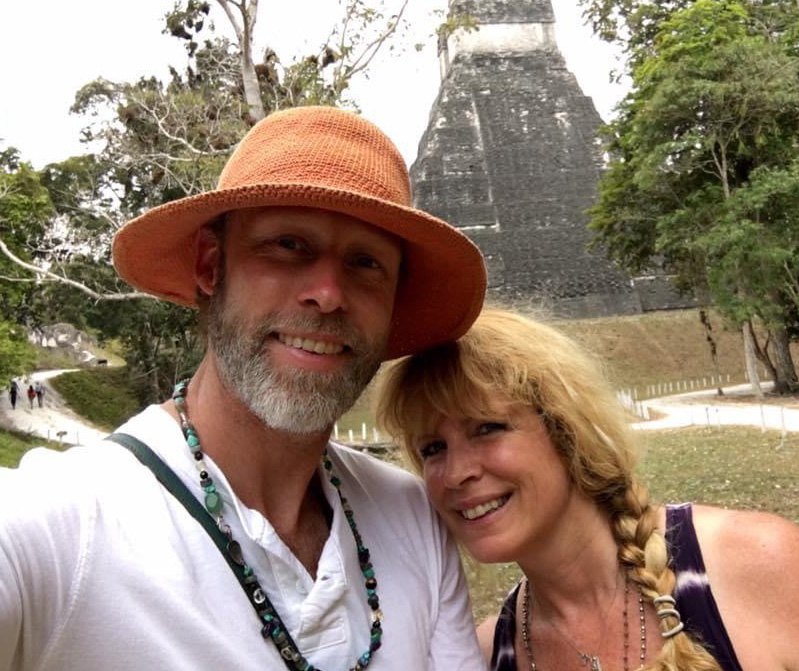
Three months earlier, I had started reading “The Seven Spiritual Laws of Success” by Deepak Chopra and decided to visit his meditation and wellness clinic in San Diego. As I grew curious about meditation’s potential benefits, someone at Chopra’s Center suggested visiting Swami Yogananda’s Ashram in Encinitas, California, mentioning its amazing meditation garden. At the time, I hadn’t consciously registered the words “swami” and “ashram.” Still, in hindsight, a synchronicity and karmic attraction pulled me to address my skipped steps this lifetime and reconnect with ancient wisdom. Within a few months, I would revisit Encinitas with my future wife, Katrina—whom I had not yet met—and experience Swami Yogananda’s grounds with a deeper perspective.
Back in my cabin that evening, I noticed I was feeling different. Something was happening. The energy, the community, immersion in nature, the food, and the yoga practices felt wholesome—something I had lost as I spiraled into delusion and destructive behaviors. I reflected on this as I tuned into the tense black line of energy on my right side again. My plan was to read, go to bed early, wake for the 5 AM meditation, and return down the mountain to my mundane morning life in Denver. Though, I had blocked off five days from work, having originally planned to be in North Carolina until I heard the voice tell me
“Don’t get on that plane.”
The Power of Mantra and Maybe I’ll Stay Another Day
Right before sunrise, the air was crisp, and I could see my breath. Above, the dark predawn sky was filled with stars and the brilliant Milky Way. Walking down the path through the forest, other devotees also moved in silence—some covering their heads with prayer shawls to keep their energy inward.
The temple was beautiful against the faint glow of the approaching sun. It was a pagoda-style sanctuary with a sweeping roof covered in blue terra-cotta tiles. Everyone entered counterclockwise, removing their shoes at the entrance.
We sat on cushions on the earth in the sweet and radiant space with candles and incense. As devotees, we all sat at the altar before many Murtis and yogic symbols of devotion. I received a booklet of Sanskrit mantras for chanting. This morning, we would chant 108 times to the fierce energy of Ganesh:
“Aum Vakratundaya Hum,
Aum Vakratundaya Hum,
Aum Vakratundaya Hum…”
Ganesh, the elephant-headed deity from the Vedic tradition, embodies the consciousness of overcoming obstacles, karmas, and beginning new life journeys.
Vedic and Vedas means “knowledge”—or perhaps better translated as “wisdom”: the wisdom of the universe that the Rishis (the Seven Seers) from the Pleiades meditated on and materialized into this plane of reality. They shared it through mantras (chanting), sacred writings, yantras (geometry), pranayama (breath practices), temple building, mathematics, cosmology, and practices of purification and realization.
Much of this wisdom was not originally written down but was known and transmitted orally, in symbols, and through the third eye or telepathically. There was no need to write it down until the state of collective consciousness on this planet began to fall, and many forgot the universal truths and who we truly are. Much of this wisdom is documented and recorded in the stones of sacred sites, temples, and pyramids, as well as within crystals and crystal skulls. It is within the unified field of the Universe, everywhere, in all places, and at all times. The key to receiving and unlocking this information is your own consciousness and heartfelt intention.
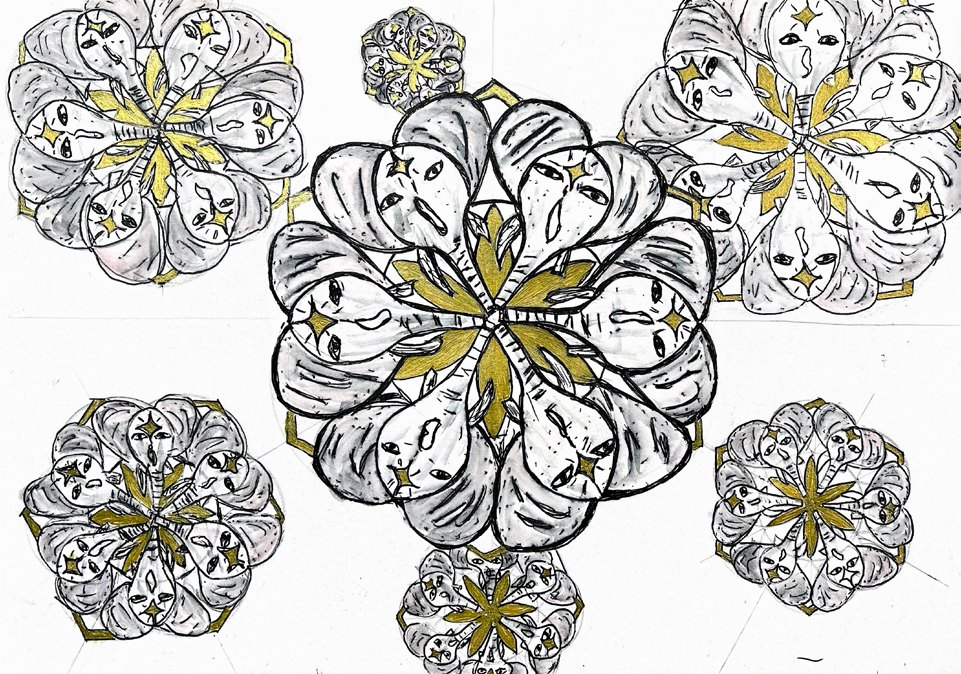
Interestingly, the yogis and Vedas define “The Rishi” and the Seven Seers as the seven openings within your head: your two eyes, two ears, two nostrils, and mouth—you and your senses are the Rishis and Seven Seers. You are the key to unlocking this cosmic knowledge.
Though this was the first time I had tried to chant Sanskrit in this life, it felt so resonant, healing, and familiar, and I fell into the groove,
“Aum Vakratundaya Hum,
Aum Vakratundaya Hum,
Aum Vakratundaya Hum…”
There is a special energy in this space that the yogis call Shakti. This temple has hosted mantra, ceremony, prayer, and devotional offerings twice daily for three decades, conducted by continuous groups of spiritual seekers. The Shakti-awakened consciousness and spiritual energy from the divine feminine felt sweet and pure in the space.
As the 108 mantras completed, we settled into a half-hour silent meditation. The sound and resonance of the mantra continued within my inner being, like ripples moving across a lake. Though I was no longer consciously chanting, my inner world and subconscious self continued the mantra. My body and spine chanted independently of my mind. It was both soothing and revitalizing, my mind floating above the space. The meditation concluded with one final.
“Aum”
The devotees and I gathered up in silence, put on our shoes, and exited the temple, completing our counterclockwise navigation of the exterior walls. Now the sun brilliantly crests the mountaintops and shines within the lapis blue sky. Though the air remained cool, people broke their silence with happy hellos, welcoming the morning. It felt good.
“Aum Vakratundaya Hum.”
Mentally, I wondered what this mantra meant, though I was already feeling and knowing its meaning in my body, energy, and emotions as a state of peace and healing.
Sanskrit is a vibrational language, along with many other ancient Mother Earth and star languages like Mayan, Hebrew, and Lakota. A vibrational language means the words and sounds resonate with inherent meaning and essence. The words vibrate through various dimensions and states of consciousness back to The Source and The One. They are part of the Universe and express a particular consciousness. The closest Western concept might be the Greek word “Logos,” used in the Bible to describe the Mind of the Supreme Being and how creation emanates from the word or Logos or mantra.
“In the beginning, the Word eternally existed.
The Word was with God, and the Word was God.”— The Gospel of John (John 1:1–2)
From a cognitive, scientific perspective, mantras are frequencies of energy like photons, gamma rays, or sound harmonics. Each mantra has a particular vibration, like the color red or the musical note “A.” Nature—or the Universe—is the source of mantra and is mantra itself. Ocean waves are a mantra; when we hear them, they elicit feelings, states of consciousness, images, senses, and intuitive knowing. Asking what a mantra specifically means is like asking what the sound of water means. Yet there is also a cognitive, linear translation.
“Aum Vakratundaya Hum” can be translated as:
- Aum — the primordial sound of God or Purusha/Prakriti
- Vakratundaya — another name for Ganesh, meaning “The Curved Trunk One.”
- Hum — a Shakti bija mantra representing the transformative fire of consciousness, Agni. It is Lightning Fire and connects to Lord Shiva and Kali-Ma.
“Aum Vakratundaya Hum”
I invoke God, the curve trunk one, and the Ultimate Truth for the grace of the transformative fire of consciousness.
For the first time in this life, I just chanted that frequency 108 times, plus the subconscious resonance that continued in my spine and body.
All of the spiritual seekers and I gathered at the main lodge for tea and breakfast. Again, I was welcomed with kindness and friendly conversation. It was close to check-out time for my one-night stay, but I wanted more. I went to ask if there was room for just one more night, to which they said, “Of course!” I would do this dance of “just one more night” every morning for the entire time that I had taken off to be in North Carolina. For all five days.
In my successive days there, I joyfully synced up to the rhythm of the ashram—my personal sanctuary. Rising at 4:30 AM, I walked under the stars to the temple, chanted mantra and meditated, shared wholesome breakfasts and communion with other seekers, walked in nature, practiced yoga, and enjoyed communal lunch conversations. Midday brought meditation, reading, and personal time. Afternoons held more yoga and evening devotions, including Kirtan—singing mantras to music, dancing, and expressing movement.
We also performed Arati, offering food, incense, prayers, fire, and other devotional items at the altars and feet of the Murtis—statues representing the yogic deities (cosmic mirrors of our own Souls and Higher Selves). These conscious energies exist both within us and in nature. As murtis, their form is usually embodied in statues made from a special alchemy of five metals to hold energetic vibrations and mantra sounds.
By the third day, I wanted to offer seva alongside the community. Seva, meaning “selfless service to another,” soon had me washing dishes, sweeping floors, stocking the pantry, and—my favorite—chopping wood!
I was becoming familiar with the staff, the devotees and the rhythm of the ashram. And now, I was even beginning to contemplate staying at the ashram for a more extended period of time as a seeker myself. Perhaps I might do a spiritual immersion for several months.
The Purifying Fire of Ceremony
On day four, I decided I would try out a different pre-dawn meditation called a Fire Puja. Puja is the Sanskrit word for ceremony and purification. Swami Shambavananda’s ashram has a special traditional temple called a Vedic Fire Temple—one of the only ones in the United States. It is specifically made for the Yajna Ceremony—a sacred fire ceremony with mantra—led by a Pujari. A pujari is a healer, initiate, or priest who leads a ceremony or Puja. The devotional attendees of the ceremony make up offerings to a sacred fire. The fire purifies whatever is offered: karma, thoughts, emotions, and anything else that is offered from the heart. I was instructed to dress warmly as this is an open-roof temple.
Rising at 5 AM in the dark, I walked under the stars to the outer walls of the sanctuary. I took off my shoes, expecting other attendees to be there doing the same. But, for whatever divine reason, it was only me and the Pujari—a gentle Soul with the Sanskrit name Naba, which refers to the belly of Lord Ganesh.
He welcomes me into the space as our breath curls up into the frigid air. He instructed me that we would be chanting the mantra
“Aum Namah Shivaya.”
We chant the mantra while offering small pinches of masala—a sacred rice mixture—to the fire each time.
Each pinch of masala is held in our right hand between the thumb and middle two fingers while making a clockwise circle around the Hridyam Heart (the Spiritual Eternal Heart) and chanting the mantra “Aum Namah Shivaya.” Then, the blessed offering is tossed into the fire along with any intentions, karmas, or thoughts I want to release.
Naba prepared the fire with ghee (clarified butter) and wood. In the frosty cold air, we sat cross-legged in the Lotus position at the fire’s edge. Naba opened the ceremony with a longer Sanskrit invocation.
I began to pray—a renewed experience for me that morning, as I had drifted away from the practice of prayer since childhood. Receiving the rice offering in my right hand, encircling it around my heart, and chanting “Aum Namah Shivaya,” I tossed the masala filled with my prayers into the fire each round.
I emptied my heart and Soul of all that had burdened me over the years: grief for my father’s death, my experience in the church I grew up in, betraying my college roommate, lying since childhood to hide my shame of self, praying for better relations with my family, cheating on my partners in later life, lying to myself, misuse of my body… The rhythm of the mantra and the crackle of the fire kept pulling memories, feelings, and karmic threads to the surface for me to see and offer up. Each time, I encircled my right hand around the Hridyam heart and tossed it into the fire.
“Aum Namah Shivaya”
Naba the Pujari maintained the rhythm, chanting and offering additional prayers in Sanskrit. Snow danced through the open roof between the flames of the fire, resting on the edges of our bodies. My back and crown felt the chill of the atmosphere, but my front glowed with warmth in the roar of the fire.
Expecting additional attendees, Naba prepared three or four other bowls of rice for fire offerings. We were now at least thirty minutes in, and I had chanted well over 108 “Aum Namah Shivaya” mantras, each accompanied by a fire offering and a burden from my heart. When mine was finished, Naba nodded for me to continue with the next offering bowl. The fire kept receiving and purifying—it had been one hour now.
Picking up my third bowl of masala, my right hand began to cramp, and my legs went numb in the cross-legged position. I had never sat this long (this lifetime) in what the yogis call Sukhasana pose. At one and a half hours, our ceremony was complete. Our offerings were done.
Unwinding my numb legs, I marveled at what had just unfolded. Time had moved differently. I must have chanted well over 1,000 mantras to Shiva, each accompanied by an offering from my heart to the fire. After a while, I had moved from my burdens to what I wanted to call in: peace, love, healing, health, truth, God, transformation, release, and forgiveness. All of those offerings cycled through my mind and body, synced with the rhythm of the fire and mantra. I had slipped into a different state of consciousness and being. I was the fire. I was the mantra. I was the Earth. And I was no longer aware of my persona and karmic weight.
Again, for the second time, I felt the power of mantra as it continued in my body and spine at a more subtle cellular level. My nervous system hummed and pulsed with “Aum Namah Shivaya.”
Stepping out to the mountain landscape, snow and sunlight danced in the wind. I certainly felt different.
I continued my day following the rhythm of the ashram, including helping in the kitchen. The whole place was feeling very familiar and right.
In the Vedic/Yogic tradition, the energy and consciousness of the One are expressed in myriad ways. Describing the Supreme Consciousness is an attempt to explain something indescribable, so many terms are used to point us in that direction. The One then manifests into the Many or Infinity.
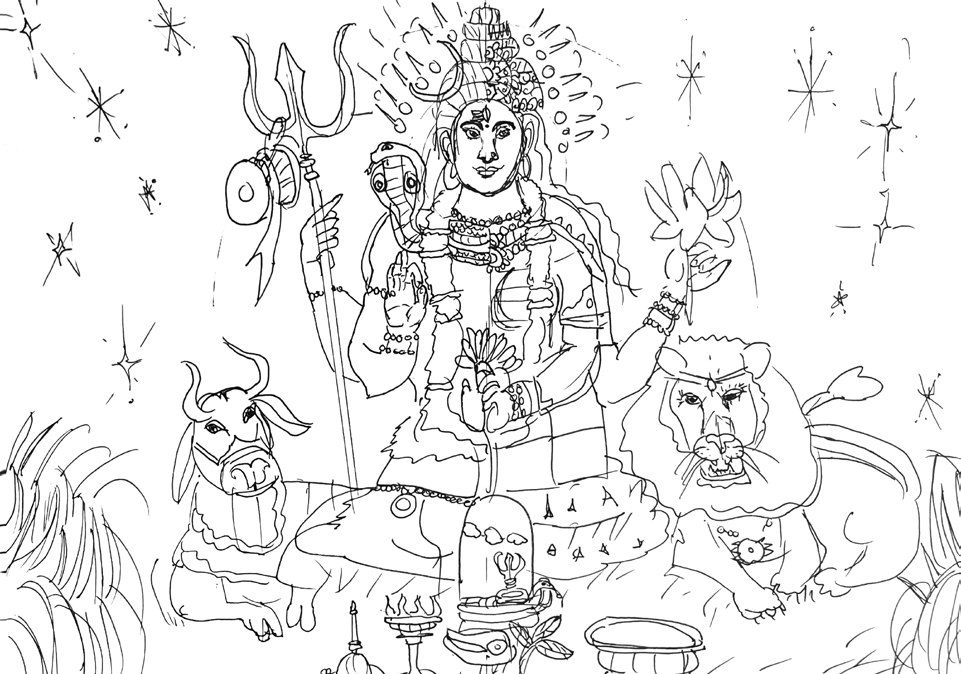
There are many Yogic deities, which one may perhaps perceive in several ways. The first is as external and separate from the self. This is called duality or Dvaita in Sanskrit. The second is connected but still separate. This is VishishtAdvaita or qualified non-duality. The third is not separate—each one of us is Pure Consciousness. This is Advaita—non-duality of consciousness. The Yogis teach that we may experience all three states within a moment, a day, and a lifetime. One state is not necessarily better than another; they simply are. All three exist as modes of our perception.
Shiva and the Cosmic Outhouse
Shiva represents the Universe’s energy coming into manifest and dissolving back into the One. Shiva is the energy of creation, destruction, and cosmic consciousness. Shiva literally means “that which is not” or “nothingness” or “Space,” to use a more modern scenic term. What existed before the Big Bang? Modern Western thinking does not have an answer to this. The ancient Vedic answer would be that which is not, or Shiva. Easy to write but perhaps transcendent and more challenging to pull out of the unconsciousness. Let me explain.
From my experience, Shiva consciousness is more than a mental awareness; it is also a feeling of pure being. Several months prior, I had a dream that was the closest I had come to understanding Shiva consciousness.
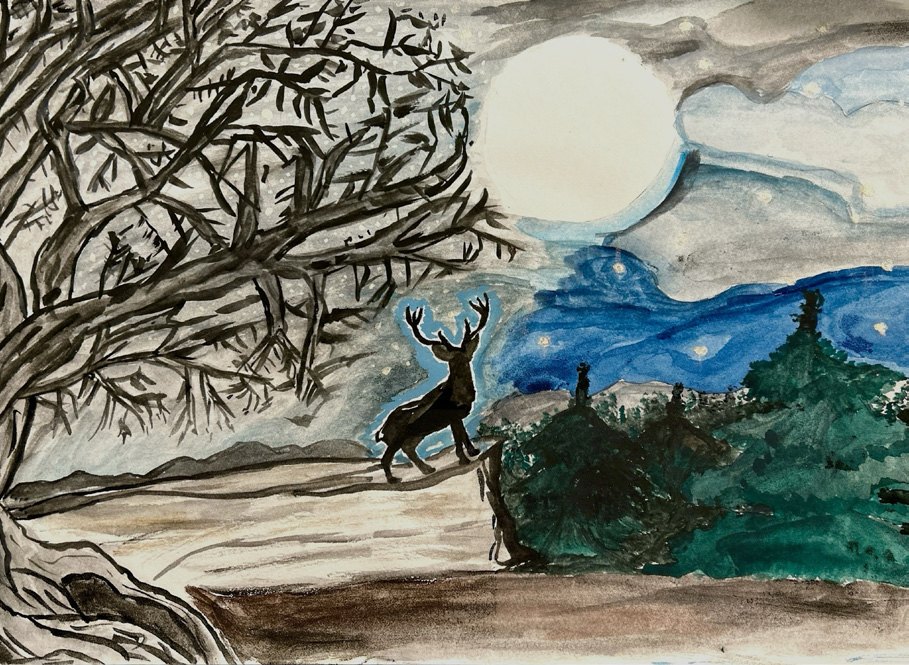
It was nighttime, and I was walking in nature under a dark and starry sky. I felt that everything was awake, alive, and conscious—the sky, the moon, the soil, the earth, the trees, the air, and the ether. Consciousness was a palpable, real feeling. I approached what looked like an old-school outhouse with a crescent moon cut into the door. Behind it was the backdrop of a rich night sky on top of a small hill. A voice/knowing emanated from the whole energetic field, similar to the one I heard five days earlier, offering up that if I passed through the door before me, I could know the One. If I was ready.
I began to step through the crescent moon door, which passed into the other side. As I did, I reeled back and was frozen. I experienced just for a moment what it was like to be in the Void of eternity and the infinity of the Universe, God, and Shiva. Everything was existing at once and the knowing was that if I was ready to merge back with the One, I had to be able to swallow it all and accept it all. I saw Nebulas, Angels, Hitler, Light, Darkness, time, endless space, infinite creation, and absolute destruction.
It was so totally beyond what my mind, body, and emotions could handle for more than a mere moment. My little ego self would have been dissolved, particle-i-zed, and expanded into the infinite, eternal Void. I could have accepted it all—Everything. But I was not ready and recoiled back through the portal, closing the crescent moon door for now.
The feeling has remained with me and is beyond words, and it helps remind my personal self that there is far more than just the third dimension and what I can think. I also feel Shiva-Energy is ultimate love or Unconditional Love. The Shiva mantra is an invocation and invitation to embody and remember that Cosmic All, within ourselves and without—non-duality and duality. Or, as the Hermetic saying goes,
“As above, so below
As within, so without
As in the Universe, so in the Soul”A paraphrase of the second verse of the Emerald Tablets
The Shiva mantra is also a key code to the five elements and the chakras. “Aum Namah Shivaya” contains meaning when broken down into syllables or seed sounds.
- Na = Earth ~ 1st Chakra
- Ma = Water ~ 2nd Chakra
- Shi = Fire ~ 3rd Chakra
- Va = Air ~ 4th Chakra
- Ya = Ether ~ 5th Chakra
- Aum = Light ~ 6th Chakra
- Silence = Beyond Duality ~ 7th Chakra
Chanting Aum Namah Shivaya is a circular mantra activating the third eye and crown back to the root and earth.
Walking Barefoot in the Snow Is a Bus Ride in the Himalayas
That afternoon, I wanted to hike in nature and work more with my mind after chanting the Shiva mantra that morning. A year later in the future, I would be in India traveling on a bus with my wife, Katrina, on a spiritual retreat called a yatra in Sanskrit. We were traveling up a narrow dirt mountain road along the Ganges River with views of the Himalayas. There was hardly room for one vehicle on the road with what seemed like a 1000-foot drop to the side. In typical style, the Indian bus driver was unfazed, driving quickly and confidently up the pass. The turns were so tight that when you looked out the window over the edge, you couldn’t see the road below. Along with the other passengers, we were leaning away from the edge. One of the teachers, Sridar, sensed the nervous energy of the group and announced

“It’s either Maya or Mantra, you choose.”
Maya is the Sanskrit word for the material illusion of form and the third-dimensional world—the dream of physical reality and the limited perceptions and projections of the Ego Mind. It’s not that the third-dimensional world lacks realness; instead, our mind and perception distort it as our karmas and misplaced desires guide us away from Soul, Truth, and Ultimate Reality. We all laughed, understanding what he meant: either trust and redirect the mind through mantra or get caught in the illusion of the material plane and fear.
Back to Shoshoni. I was gearing up for my hike. I wanted to go barefoot through the forest and snow to a place called Buddha Rock. The round-trip was 2½ miles of intermittent earth and late spring snow through the forest. I was determined to redirect my mind so that the sensation of snow and cold was a matter of perception or Maya.
Walking barefoot through the woods, I stepped over roots, earth, rocks, mountain streams, ice, and snow. I continually chanted “Aum Namah Shivaya” and practiced breathing deep and slow. When my mind wandered, my breath quickened, or I tried to walk quickly, I became more aware of the perception of cold and pain. When my breath slowed, and I walked intentionally with each step and chanted, I could dissolve feelings of cold and redirect energy to my feet to stay warm. There were moments and stretches of bigger snow patches that definitely challenged my willpower. However, this walking barefoot meditation gave me good practice in the power of breath, mind, and mantra. Or, as I would say in the future,
“It’s either Maya or Mantra, you choose.”
The Church, The Amish, and My Love of Nature
This was my last evening at the ashram, five days after hearing the message
“Don’t get on that plane.”
I planned to attend evening meditation, have dinner, read a bit, and then wake at 5 AM for one final mantra meditation before driving down the mountain to resume my work as the music school director. These days had been the most healing of my life.
Alone in my dorm-style room with its simple bunk bed, I had been reading “Rudi And The Green Apple” each night. Written by Swami Shambavananda and his wife, Faith Stone, the book chronicled their spiritual journey with their teacher, Swami Rudrananda (Swami Rudi).
Faith and her future husband—who would later become Swami Shambavananda—found themselves seeking spiritual truth as teenagers in 1960s New York City. It was a transformative time marked by the cosmic alignment of Pluto and Uranus (1965–67), an era when many young Souls were awakening to Eastern and broader spiritual wisdom. Their paths led them to Swami Rudi’s Manhattan ashram, where they immersed themselves in yoga, meditation, and Vedic teachings.
Perhaps you are familiar with Rudi’s Bread. Years later, in 1979, Shambavananda honored his teacher’s memory by founding this company in Colorado, creating wholesome, organic bread to nourish the Soul.
Shambavananda, whose name means “with senses open and awareness within,” grew up in an Italian-American family on a Pennsylvania dairy farm. His mother was devoted to a small Christian church called The Worldwide Church of God, which embraced both the Old and New Testaments.
Shambavananda’s upbringing in this church held unexpected synchronicities with my own life. The Worldwide Church of God (WWCG) followed practices that bridged Christian and Jewish traditions—holding services on Saturdays, observing the Sabbath from Friday sundown to Saturday sunset, avoiding pork and shellfish, and celebrating Passover, the Day of Atonement, and the Feast of Tabernacles. At the time, I knew none of this—the book Rudi And The Green Apple only briefly mentioned Shambavananda’s “devoted Christian mother.”
The additional backstory emerged a month later during a conversation with Faith. When I shared that I’d been raised in the Worldwide Church of God, she casually replied, “Oh, that’s the same church that my husband, Swami, was raised in by his mother.”
This revelation struck me deeply. Since leaving the church at 18—my first nodal return—I hadn’t met another former member. Now, at 36.5 years old, during my second nodal return, I would encounter two: Swami Shambavananda and, three months later, my future wife, Katrina.
The Worldwide Church of God, which peaked at 1.5 million members, began in the 1930s with a vision of returning to simpler, more wholesome religious practices and ways of life in harmony with God and Nature. Many of their principles around health, food, and community still resonate with me: eating natural, unprocessed foods, supporting local artisans, knowing the people who produce your food, and gathering in community to share spiritual teachings.
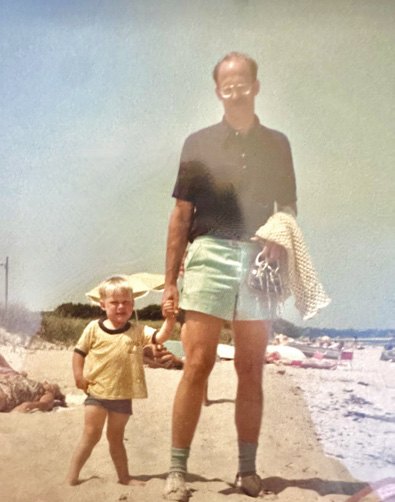
Our church’s food co-op connection with Amish farmers enriched our family and my childhood. Those hour-long drives into farm country with my father remain treasured memories—collecting fresh eggs from the henhouse, wheels of handmade cheese, fresh unpasteurized milk, whole-grain bread, golden honey from local beekeepers, and crystal-clear spring water that bubbled up from the earth itself. I can still picture following farmer Eli by kerosene lantern light into the barn at dusk, feeding hay to the cows, and treating the horses to sugar cubes.
Summer evenings in the Amish countryside were magical: fields aglow with thousands of fireflies, the air rich with earthy fragrances, and dark skies brilliant with stars. Here, my father and the farmers taught me to find the constellations—the Big Dipper, the Little Dipper, the North Star. In fall and winter, we’d watch Orion the Hunter rise in the east over harvested cornfields and silhouetted forests. These quiet moments with my dad gave me a profound sense of peace and connection to Mother Earth and farm life.
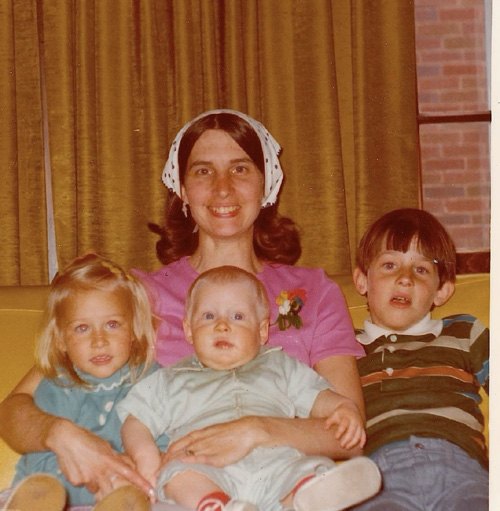
My mother, Cathy, who balanced being a full-time nurse with her passions as an artisan, crafter, master gardener, and cook, shaped my own connection to hearth and home. In the kitchen and our backyard garden, she taught me to cook, bake, garden, read, explore, and create. Most importantly, she instilled in me a deep love and respect for Nature and Mother Earth. While these values aligned with our church’s principles, I later realized they stemmed primarily from my parents’ beautiful hearts and genuine way of being in the world.
As the 1980s merged into the early 1990s, the church’s teachings shifted more toward the Book of Revelation, end-times prophecies, and the notion of being the Chosen Ones. These messages never truly resonated in my heart, and I sensed my parents felt the same quiet disconnect. But they had invested so much of their lives and identities with the religion since the late 1960s—a spiritual journey for them and the collective—that again began around the time of the transformative Pluto/Uranus conjunction.

The church began predicting end dates for the world in the 1980s and instructed its followers that they were the chosen people who would be spared during the apocalyptic times. As expected, the end-time dates came and went, and the church fractured over the teachings and had many power struggles for control.
Our family finally left the church unceremoniously, and it was sparsely spoken of throughout the following years. I had never fully understood why my parents entered the church, and I was still unresolved about the experience. I now have a different perspective on life with two stepsons and a renewed connection to my spiritual path. I can understand and have great compassion and love for their choice. I can see the beauty in the intention of the church to manifest a more beautiful world. At a Soul level, this was my karma and choice to experience this incarnation; ultimately, and finally, it comes back to me.
In October 2003, my father died suddenly of a blood clot in his lungs. His sudden death, the church experience, and my suppression of my own Soul spiraled me into some destructive karmic behaviors and patterns. I was finally becoming willing to examine these karmic cycles. The five days I spent at the ashram provided a sanctuary where I could pause, reflect, and begin healing—allowing me to dig deeper into my Soul’s truth.
That night, I lay in bed reading “Rudi And The Green Apple” and contemplated what was to come when I would leave tomorrow morning and return to the world.
How to Celebrate Death and Shaktipat
My alarm went off one final time at 5 AM, and I rose in the cool morning, walked under the stars to the temple, and joined the community for meditation, mantra, and prayer. Again, I felt a deep resonance with these ancient practices and wondered how I might be able to stay at the ashram longer. Perhaps I would even quit my job, I thought. I walked back to my bunk room in the crisp morning sun, smiling at the trees, the landscape, and the grounds. In my room, I picked up the book “Rudi And The Green Apple” and decided to read one more short chapter before I was to go: “How to Celebrate Death.”
Swami Rudi had known that he would die during his 45th year and transition into the Spirit world. Understanding this, he wanted to gather together all of his students and devotees so they could celebrate him, say goodbye, and understand how to honor a Soul when they transition—or as the yogis call it, enter Maha Samadhi—the great bliss, enlightenment, or Absolute Truth.
So, on his 45th birthday, many friends, students, and devotees gathered with Rudi at his ashram in New York. Rudi explained that he had foreseen his death and that he was at peace with it. He continued to share that for himself or anyone who transitions to the other side, it is best to send them out with as much light and love as possible because the Soul is now continuing its journey, and this earthly chapter is done. While it is okay to grieve and feel your heart, the transitioning Soul can get weighed down by those who are unable to let go for whatever reason. He guided his community to send his Soul and any other Soul to the Spirit world freely.
Indeed, one month later, Swami Rudi was flying in a four-passenger prop airplane that crashed into a foggy Catskills mountainside. He died instantly on impact, but the other three passengers all walked away with minor injuries. As I read this, I remembered that when my dad died, I had not freely sent him out with pure light and love. And, I still had much unresolved about his death 10 years later now in this moment. I closed the book and turned to grab my bags as I looked up at the window…
In a flash of light, I fell to the floor and expanded beyond my known self into what I now know as my eternal Soul Self—the Atman. I left the time-space reality of that room and my body, and entered the dimension of light. The experience was beyond words and beyond cognition to fully understand, but not beyond the understanding of my Spiritual Heart. I saw hundreds of experiences and moments in my life spanning from a week ago to my birth.
“This is done.
Let go of that.
You no longer need this,
That is over…”
The energy and Soul imprints of many struggles, karmas, samskaras, pains, blockages, and denial of my own spiritual Self expanded beyond the limits of my former mind and ego identification. It was as if a veil of illusion had been lifted from within and without, and in those moments beyond moments, I experienced God and my truest Self. It felt as if a cork was pulled from my being and a whole bunch of karmic baggage drained out into pure white light.
I burst into tears and drifted in and out of the physical realm and into the next, sobbing from my Soul. I would occasionally pull myself back into my body and then expand back out for what was an eternity on the other side.
Perhaps 30 minutes of physical time elapsed before I could regain the ability to come to my feet. I had what may be described as a “near-death experience” where one’s life flashes before their eyes.
I staggered to the door in a state of radiant disbelief, my consciousness reflecting divine light. There were no words or current mental understandings of what just happened. Stepping outside into nature, I entered a world transformed by Grace. The colors of everything pulsed with their own inner light—each leaf, each blade of grass sparkled with divine consciousness. I could feel and see the Spirit energy flowing through the earth, dancing up through the trees and spiraling into the heart of the sky. And oh my, the sky! It was an ocean of living blue consciousness, so radiantly numinous that it brought tears of joy to my eyes. The depths of the sky swelled in my heart with a love beyond any former knowing. I felt light—literally and figuratively.
I had no tools to describe what just happened as it was both beyond words and any frame of reference I had ever known. I later learned that the yogis have a word for what happened: Shaktipat. Shakti is your own individual spiritual energy that comes from the One. When it is in the universal form, it is called Kundalini. All beings have the universal life force of Kundalini flowing through them in the form of personal Shakti—trees, people, stars, rocks, Gods, and the Goddess. Shakti is also one of the feminine divine names and aspects of the One.
Shiva and Shakti are the solar and lunar, yin and yang, material and non-material, masculine and feminine, or Purusha and Prakriti, to use Sanskrit terms.
“Pat” means to fall or descend from heaven or a lightning bolt. Shaktipat is the descending Grace of The Goddess and Spirit. So, Shaktipat is an awakening of the Soul and Spirit to the personal self. Or a revelation and lightning bolt that has fallen from heaven and the upper realms of consciousness. Sanskrit and the yogic wisdom tradition have words and symbols for states of being that we have forgotten in modern times.
My future wife Katrina would introduce me to this concept three months later. She is so beautiful in all the ways. In the Western mind, our closest words for a Shaktipat might be awakening, illumination, or revelation.
Standing in an absolute state of awe, I could feel and see at a different level than my physical self. I could see the energy, Lifeforce, and Shakti coming off everything: buildings, plants, earth, sky, clouds, and people. My heart had come awake, and I felt a deep love for myself that I had not known since I was five years old when I knowingly distanced myself from that connection. I felt such deep love for the people walking around the ashram, and for the first time since I was five, I felt Universal Love again.
I felt love in the sky; I felt the clouds and rain nourish the Earth with love, and I felt the Spirit of the trees as a nation growing up to the stars and filling the Earth with love. The whole world is love.
Again, it overwhelmed me as I cried tears of love looking up at the sky. I literally felt like I had been reborn out of a dark place of myself and passed through a birth canal, reaching the other side in an absolute and total state of wonder.
Since that day, the world has transformed. I experienced my death in this life and was resurrected to a deeper part of my Soul. As I would learn, this was the start of a whole different journey: the journey to continually birth, grow, die, and be reborn to myself again and again. This all began by trusting a moment of intuition that did not say why but spoke,
“Do not get on that plane.”